|
Reconstruction of the Historic
Sauer Organ of Goethe-Gymnasium Berlin
|
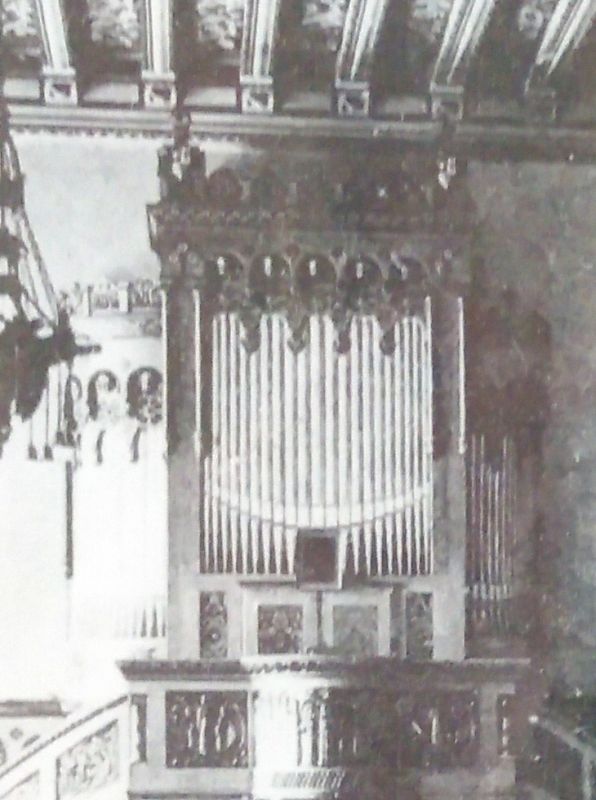
The Sauer Organ around 1910
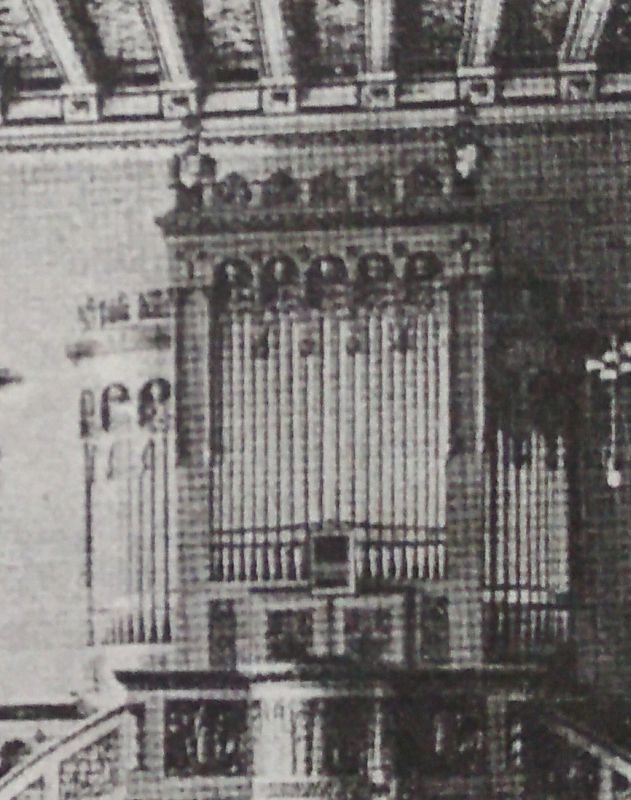
The Sauer Organ around 1924
|
Since our school organ was built in 1904 for the then Viktoria-Louise School by court organ builder Wilhelm Sauer, who at the same time was also building the famous organ of Berlin Cathedral, it has had a long and eventful history. Numerous historic newspaper reports trace the highly acclaimed concerts that took place in this assembly hall until 1938. Eventually, even the capital's conservatory moved into the building that is now Goethe-Gymnasium. The Berlin Philharmonic rehearsed here for a time, as did young students who would later become renowned performers. The building and the organ survived the Second World War almost unscathed, and today the Sauer organ of Goethe-Gymnasium is Berlin's last historic school organ that remains playable.
Today, because of its age of more than one hundred years alone, the Sauer organ has numerous technical defects, and there is a risk that the instrument could once again become unplayable, as it was between 2004 and 2007. This is largely due to the fact that, depending on available funds, repairs have so far been carried out more as emergency measures than as sustainable interventions, and a fundamental concept for lasting restoration has therefore been lacking.
Our aim is to pursue a historically faithful restoration of the instrument to its original 1904 state with the necessary long-term sustainability. This includes:
- restoration of the technical system
- restoration of the original specification,
- conversion and stylistically appropriate reconstruction of the pneumatic action,
- and, above all, reconstruction of the historic case with the original façade-pipe lengths, reusing the original basic structure.
It is a mammoth project that will require goodwill, commitment, passion and courage and will certainly take several years. At the end of that path, we hope that the instrument will not only shine again in its former visual and tonal beauty, but will also remain available to future generations as a durable and sustainable source of musical education and inspiration.
|
 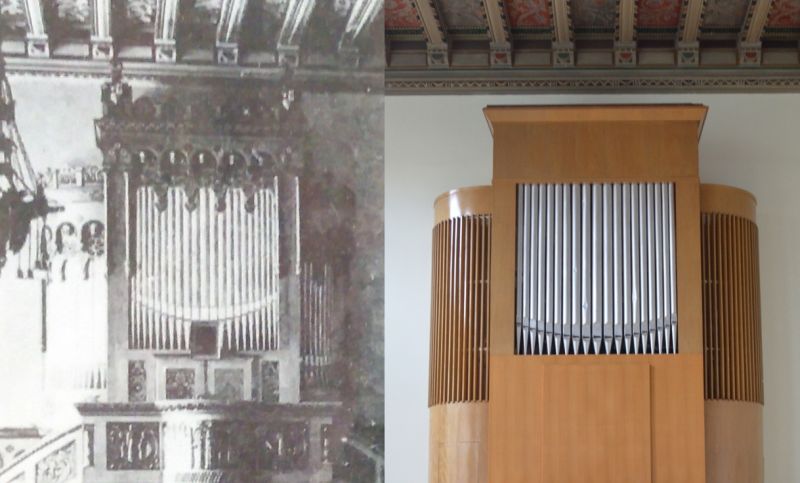
Goethe-Gymnasium Berlin (then Viktoria-Louise School) around 1910 — comparison of the organ around 1910 and today
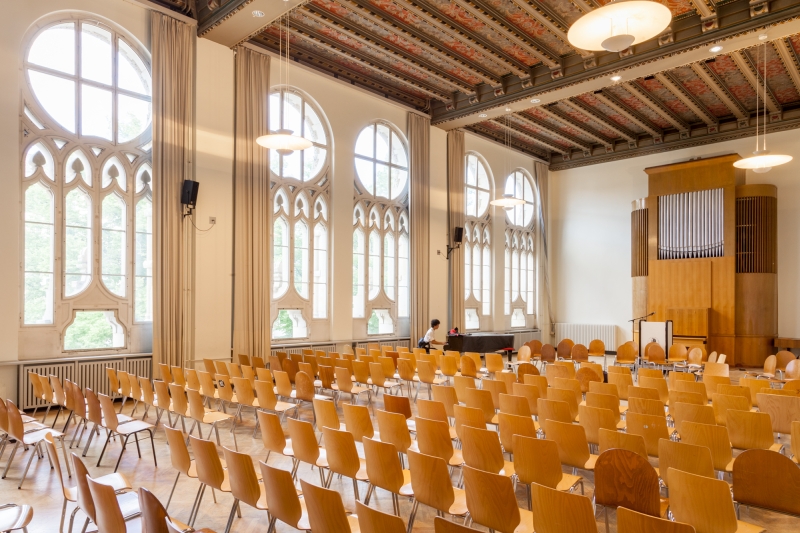 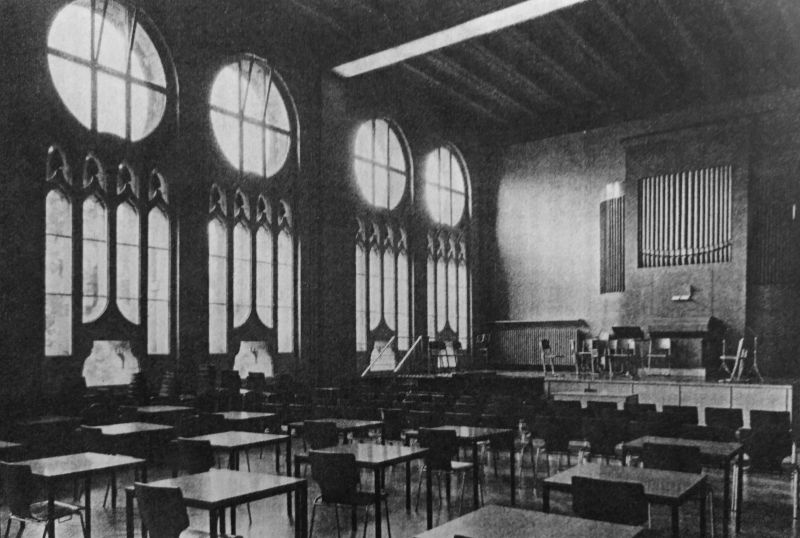
Assembly hall of Goethe-Gymnasium today and around 1985
| Original specification (1904) | Present specification (2020) | | | |
Manual I (C-f''')
Principal 8'
Bourdon 8'
Gemshorn 8'
Octave 4'
Mixtur III
Manual II (C-f''')
Spitzflöte 8'
Lieblichgedackt 8'
Aeoline 8'
Vox céleste 8'
Vox humana 8'
| | Pedal (C-d')
Subbaß 16'
Violoncello 8'
| |
Manual I (C-f''')
Principal 8' (original)
Bourdon 8' (original)
Octave 4' (original)
Principal 2' (1954)
Mixtur III (historical stock of uncertain origin)
Manual II (C-f''')
Spitzflöte 8' (original)
Lieblichgedackt 8' (original)
Feinflöte 4' (historical stock of uncertain origin)
Principal 2' (1954)
Quinte 1 1/3' (1954)
| | Pedal (C-d')
Subbaß 16' (original)
Violoncello 8' (original) | |
|
The Historic Pipework of the
Sauer Organ of Goethe-Gymnasium Berlin
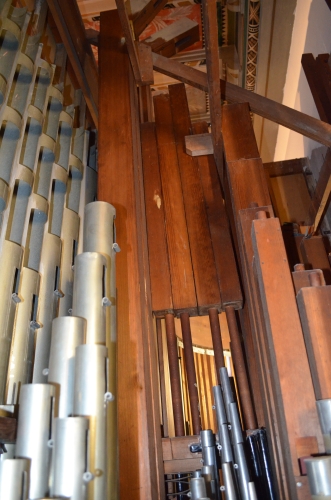
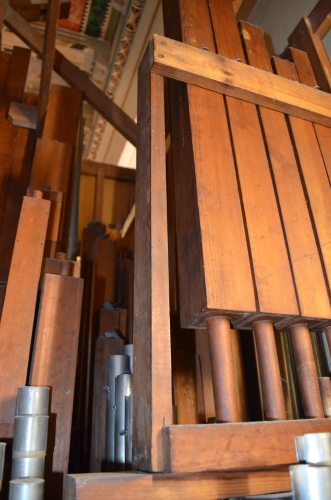
The Sauer organ of Goethe-Gymnasium still retains a substantial amount of historic pipework, making a stylistically faithful restoration a meaningful proposition. Eight of the twelve stops survive in almost original form, although many original pipes were repurposed and incorporated into other stops. In addition, the organ contains a considerable number of historic pipes from other sources dating from before 1945 that have not yet been definitively assigned to the original specification.
The pipework currently present can be divided into at least four groups.
|
1. Original pipework:
|
Principal 8', Octave 4', Spitzflöte 8', Gedackt 8', as well as Subbaß 16' and Violon 8'
|
|
2. Altered original pipework:
|
Bordun 8' and Feinflöte 4'
(In the Bordun 8', many pipes bear the inscription Bordun 16'; pipes from Voix celeste 8' were incorporated into the Feinflöte 4')
|
|
3. New pipes (1950s):
|
Gemshorn 2', Principal 2', Quinte 1 1/3'
|
|
4. Historic pipes from other sources:
|
from historic stock, mostly used to supplement the treble ranges of the original stops
|
|
Reconstruction of the Historic Case
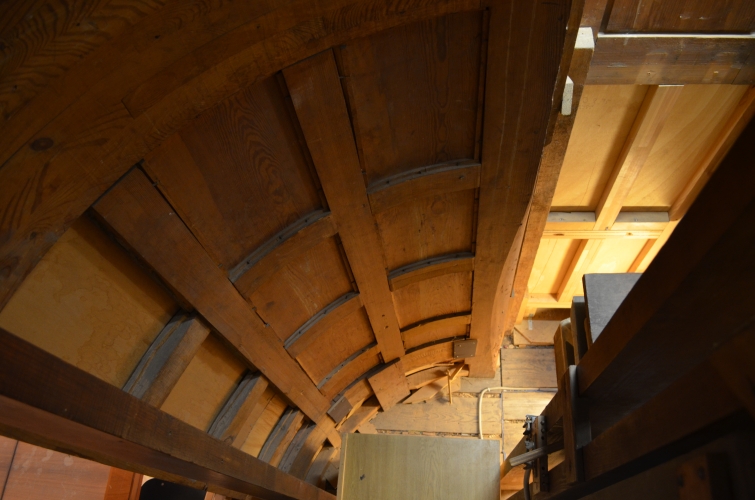
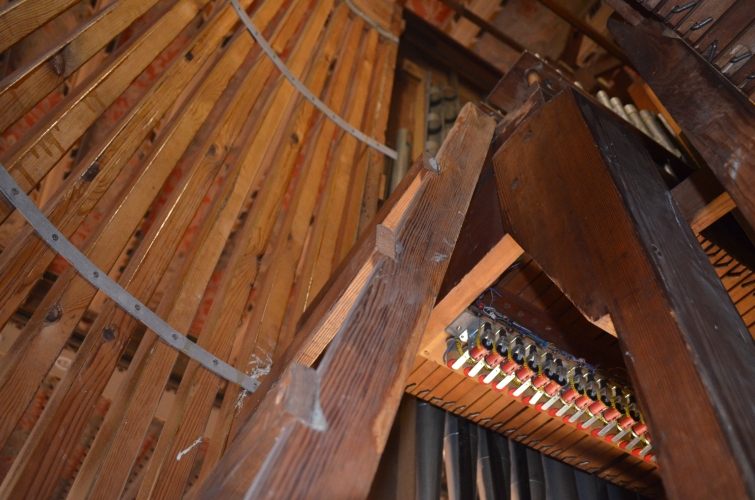
The removal of the Sauer organ's historic Art Nouveau case appears puzzling today, and not only from the perspective of heritage conservation. From a report dating from 1954, we know that the case was still in place at that time and that questions of style, rather than structural necessity, seem to have been decisive in its later removal.
The report of 18 October 1956 states: "As an addendum to my report of yesterday, I would like to suggest for consideration whether, since there is in any case an intention to provide the organ side of the hall with an 80 cm-high platform, the console might be relocated in order to save space. This would eliminate the stairways leading to it, which at present merely take up space. The extent to which the Art Nouveau organ case, with its two outer sections, should retain its present form in the redesign of the hall must remain subject to further consideration."
The present case, installed in 1957, now shows considerable damage and was already constructed at the time using inferior materials. In addition, the relocation of the console in 1993 created a mismatch between old and new timber, while the former console opening was only provisionally closed. A report from 2005 concludes: "Nevertheless, restoring at least an approximation of the case's former form would be a question of this organ's identity. That identity has been lost in every respect, both tonally and visually."
One of the project's essential tasks will therefore be to restore the historic case as far as it can be reconstructed.
|

|
Console Position and Stairways
As proposed in the 1957 report, a platform approximately 80 cm high was built around the organ, and the historic case, pulpit and stairways to the console were removed. The new console was installed halfway between its original position and floor level, as can be seen in this 1985 photograph (source: Goethe-Jahrbuch, 1985, p. 14).
In 1993, after removal of the platform, the console was finally moved down to floor level and the resulting opening in the case was closed.
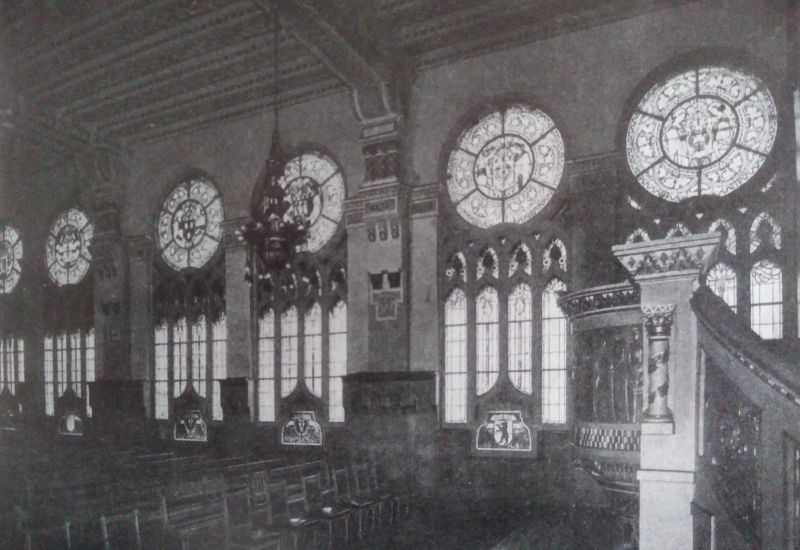
View of the historic assembly hall from the organ pulpit (source: Helmut Pieper, Historisches Portrait. Eine Berliner Schulgeschichte (2007), p. 47).
Original Façade-Pipe Lengths
As can be seen by comparing the two historic images with the present condition, the organ's façade pipes no longer corresponded to the original state by 1924. The organ is shown here around 1910 on the left, in 2020 in the centre, and around 1924 on the right. It is very likely that the original façade pipes were requisitioned during the First World War and replaced by 1924.
According to a report from 2007, the current façade pipes are more than 70 years old. The photograph also shows that the number of pipes was reduced from 21 to 19. The organ still has 19 façade pipes today. On the basis of current knowledge, it is unclear how these changes came about. The original state therefore remains the benchmark to be pursued.
|
The Hauptwerk Sample Set of the Sauer Organ
The Sauer Organ — Digital!
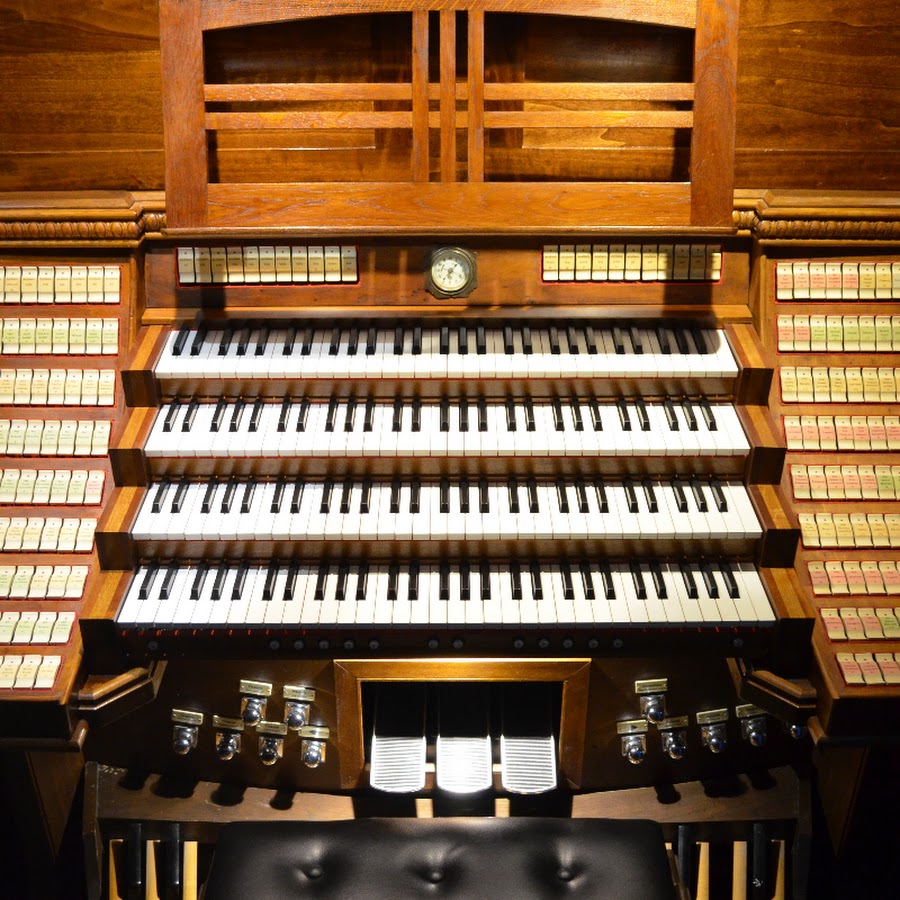
In October 2020, a digital Hauptwerk sample set of the Sauer organ at Goethe-Gymnasium was created. Every individual note of every individual stop was recorded separately in three stereo channels. This makes it possible to experience the Sauer organ virtually, with a continuously variable perspective between the room and the console.
The Sauer Organ in Music Education!
The virtual reconstruction of the Sauer organ now makes it possible for anyone to play the school organ at home from a Hauptwerk console or keyboard. The Sauer organ is therefore also available at any time for digital teaching without access to the assembly hall.
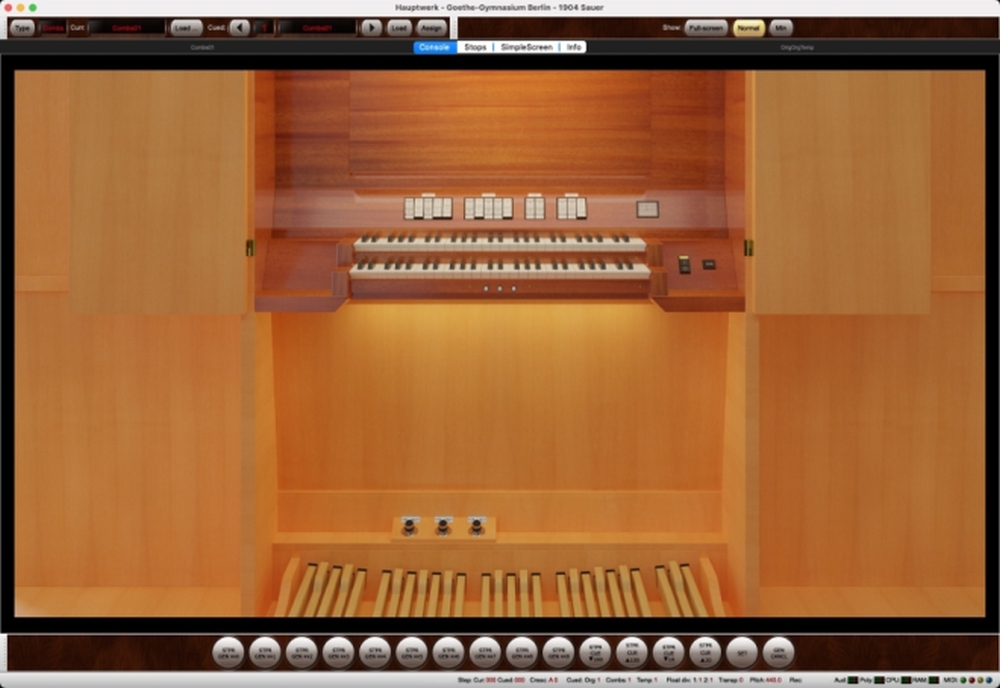
The Digital Console
(Christoph Schmitz | www.hauptwerk-organ.com)
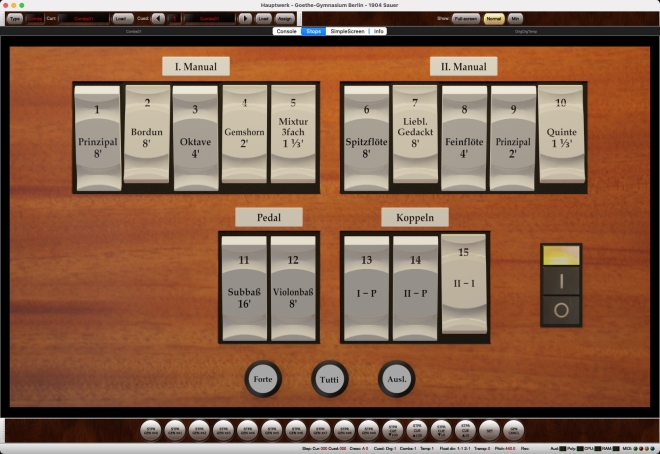 In addition, the digitisation of the Sauer organ documents the present condition of every individual pipe, which will also be of great value for reconstructing the organ's original state. In addition, the digitisation of the Sauer organ documents the present condition of every individual pipe, which will also be of great value for reconstructing the organ's original state.
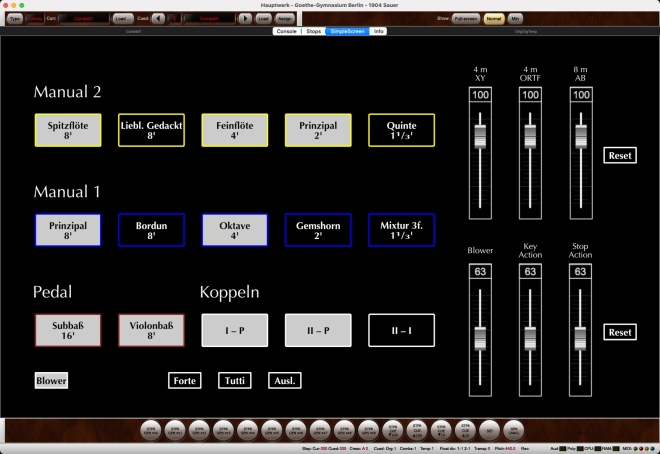
The Stop Screen
(Christoph Schmitz | www.hauptwerk-organ.com)
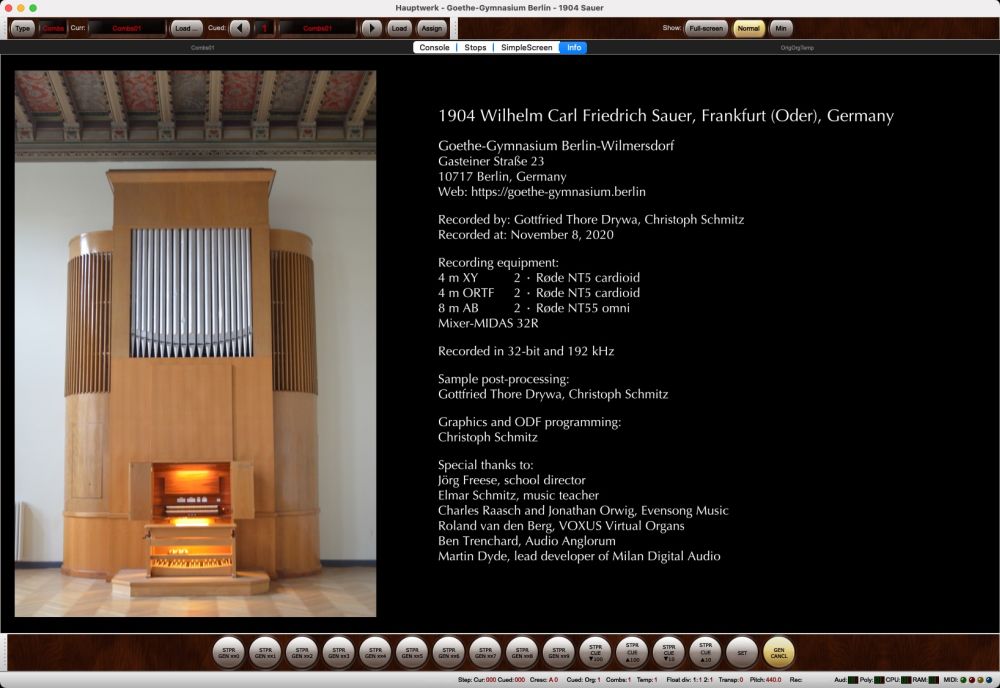
Recording Technique in Three Stereo ChannelsThe Sauer organ was sampled in three stereo channels at 32-bit / 196 kHz.
- 4 metres from the console in XY configuration with Rode NT5 cardioid microphones
- 4 metres from the console in ORTF configuration with Rode NT5 cardioid microphones
- 8 metres from the console in AB configuration with Rode NT5 omni microphones
- using a MIDAS 32R
|